
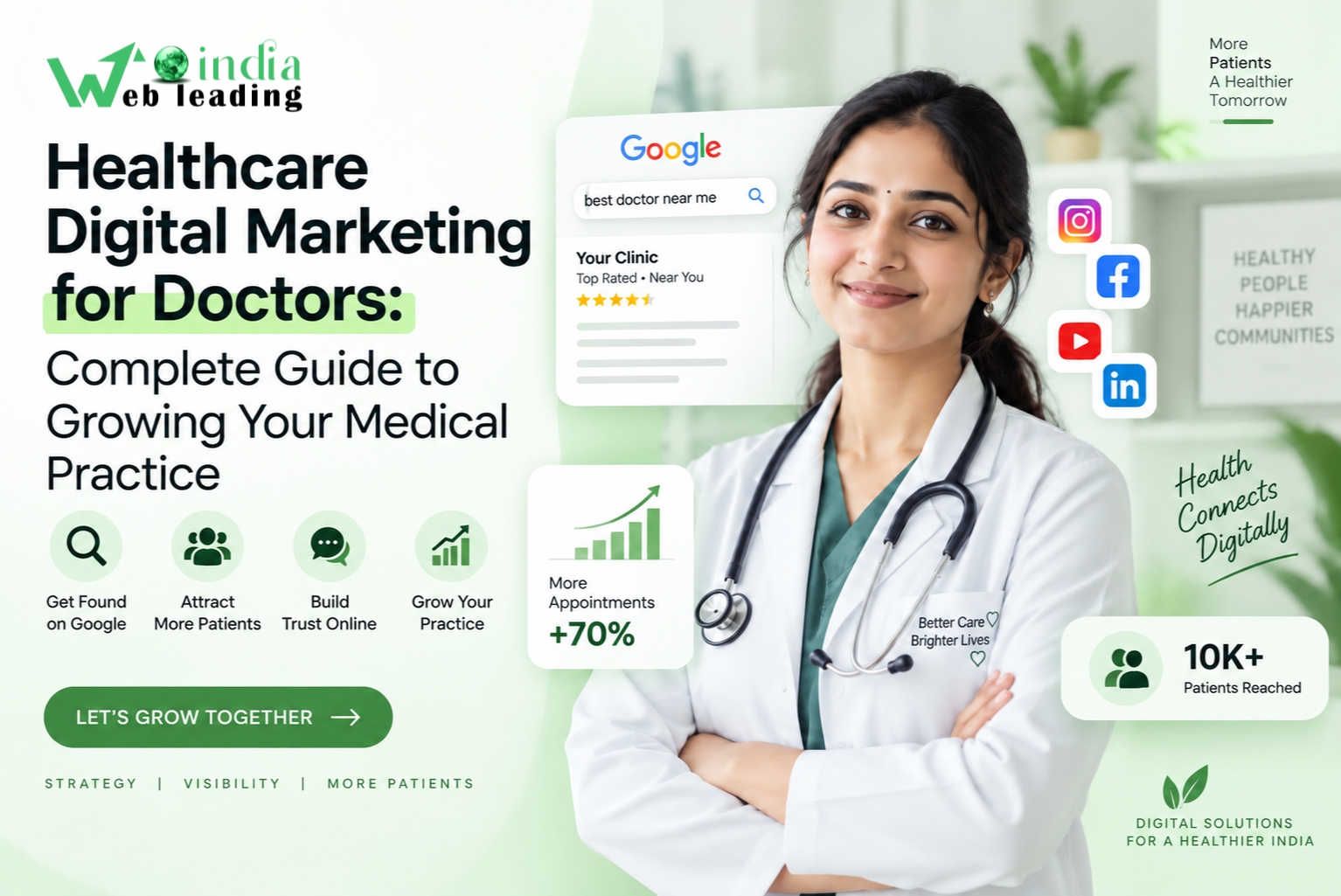
77% of patients use search engines before booking an appointment. If your practice isn't visible online, you're losing patients to competitors who are. Your digital reputation is now your new front door.
Key stat: 84% of patients check online reviews before selecting a provider, and 61% trust these reviews more than personal recommendations. Meanwhile, 32% of U.S. adults now use AI chatbots (ChatGPT, Gemini) for health information.
This guide covers everything you need — from SEO and content marketing to paid ads, reputation management, and AI search optimization. Whether you're a solo practitioner or part of a multi-specialty clinic, these strategies will help you attract more patients and grow your practice.
Web Leading India (webleadingindia.com) specializes in healthcare digital marketing and can help you implement these strategies effectively.
Why Digital Marketing Matters for Doctors
The New Patient Journey
Patients today follow a clear digital path:
- Research: Google symptoms, conditions, and treatment options
- Discovery: Search for "best [specialist] near me"
- Evaluation: Read reviews, check credentials, compare options
- Decision: Book an appointment with the provider who appears most credible
AI Is Changing Everything
AI tools like ChatGPT, Perplexity, and Google Gemini are now part of the patient journey. This means Generative Engine Optimization (GEO) is just as important as traditional SEO. Your content must be optimized for both search engines and AI-powered answers.
Medical SEO – The Foundation of Practice Growth
What Is Medical SEO?
Medical SEO is the process of optimizing your online presence to rank higher in search results for healthcare queries. When someone searches "cardiologist near me" or "best dermatologist for acne," your practice should appear prominently.
Keyword Research
Target long-tail keywords (3+ words) for better conversion rates:
- "Pediatric allergist in Mumbai"
- "Best fertility specialist for PCOS"
- "Root canal treatment cost in Delhi"
Use tools like Google Keyword Planner, Ahrefs, or Semrush.
Local SEO
- Google Business Profile: Keep it complete — name, address, phone, hours, services, photos
- NAP Consistency: Ensure Name, Address, Phone match across all directories
- Local keywords: Use location-specific terms in your content
Content Marketing That Ranks
Google evaluates E-E-A-T:
- Experience: Real-world experience
- Expertise: Qualifications to discuss the topic
- Authoritativeness: Recognition from other experts
- Trustworthiness: Can patients trust your information?
Content ideas: Blog posts, FAQs, treatment descriptions, patient testimonials, prevention guides.
Technical SEO
- Fast-loading (check with Google PageSpeed Insights)
- Mobile-friendly
- HTTPS/SSL secure
- Easy navigation
Schema Markup
Add structured data for:
- MedicalBusiness – practice details
- Physician – doctor profiles
- FAQPage – Q&A blocks
- Review – ratings and testimonials
WordPress plugins like Rank Math and Yoast can generate schema markup automatically.
Backlinks
Build authority through:
- Medical directories and association listings
- Guest posts on health publications
- Link-worthy content (guides, infographics, research summaries)
AI-Powered Search – The New Digital Front Door
What Is Generative Engine Optimization (GEO)?
AI tools synthesize information to provide direct answers. GEO optimizes your content so AI systems (ChatGPT, Gemini, Perplexity) use your information in their responses.
How to Optimize for AI Search
- Think like a patient: Answer specific questions directly
- Create answer-first content: Put the answer immediately, then add details
- Build topic authority: Cover every question on a subject
- Use schema markup: Helps AI extract your information
The Zero-Click Era
Many patients get answers directly on search results without clicking through. Aim for featured snippets, AI Overviews, and "People Also Ask" sections.
Online Reviews and Reputation Management
75% of patients check reviews before choosing a provider. Most read at least five reviews.
Best Practices
- Automate review requests: SMS or email after appointments — 50% more feedback
- Showcase positive reviews: Feature testimonials on your website
- Respond to all reviews: Thank for positive, address negative professionally
- Never share patient details publicly — maintain privacy
- Have a crisis management plan — monitor and respond quickly
SEO impact: Positive reviews signal trust to Google. Practices with ratings above 4.5 stars attract significantly more inquiries.
Paid Advertising – Accelerating Patient Acquisition
Organic vs. Paid
- Organic (SEO, content) – builds long-term trust, takes time
- Paid (Google Ads, social ads) – generates immediate results
Best strategy: Use both.
Google Ads for Doctors
Target high-intent keywords:
- "Allergy testing near me"
- "Pediatric asthma doctor [city]"
- Competitor brand names
Must comply with healthcare advertising regulations.
Key Advertising Metrics
| Metric | Target | Red Flag |
|---|---|---|
| Patient Acquisition Cost | <33% of LTV | >50% of LTV |
| Conversion Rate | 5–12% | <3% |
| LTV to CAC Ratio | 3:1 to 5:1 | <2:1 |
Social Media and Content Marketing
Build Trust Through Education
Patients trust doctors who educate them. Publish informative content consistently.
Content formats that work:
- Blog posts on symptoms, treatments, prevention
- FAQs answering patient questions
- Patient success stories (with consent)
- Videos explaining procedures
- Health awareness posts
Platforms
- Facebook: Community building
- Instagram: Behind-the-scenes, humanize your practice
- YouTube: Educational videos
- LinkedIn: Professional credibility
Website Optimization and Patient Experience
Must-Haves
- Mobile-friendly – 80%+ patients search on phones
- Fast loading – check with Google PageSpeed Insights
- Easy booking – one-click appointment scheduling
- Security – SSL certificates, secure forms
- Clear navigation – contact info, services, doctor profiles easily accessible
Measuring Success – The KPIs That Matter
Essential Metrics Every Practice Should Track
| KPI | Target Range | Red Flag |
|---|---|---|
| New Patient Volume | 10–15% YoY growth | Flat or declining |
| Patient Acquisition Cost | <33% of LTV | >50% of LTV |
| Conversion Rate | 5–12% | <3% |
| LTV to CAC Ratio | 3:1 to 5:1 | <2:1 |
| Appointment Show Rate | 75–85% | <70% |
Analytics Tools
- Google Analytics: Website traffic and behavior
- Google Search Console: Search performance
- Call tracking: Track which channels drive phone calls
- Heatmaps: Understand how patients interact with your site
- Conversion tracking: Measure appointment bookings from every channel
Pro tip: Set up conversion tracking for appointment forms and calls so you know exactly which channels deliver patients.
Common Mistakes to Avoid
- Neglecting mobile optimization — Over 80% of patients search on phones
- Ignoring negative reviews — Respond professionally to all feedback
- Creating generic content — Address specific patient concerns
- Forgetting website security — SSL and compliance are non-negotiable
- Expecting overnight results — Digital marketing is a long-term investment
- Not tracking ROI — You can't improve what you don't measure
- Skipping schema markup — AI systems rely on structured data
How to Succeed
- Audit your current online presence — Google your practice and analyze what patients see
- Identify gaps — Compare yourself to competitors
- Prioritize improvements — Start with the highest-impact changes first
Getting Started – Your Digital Marketing Roadmap
Phase 1: Foundation (Month 1-2)
- Audit your online presence
- Optimize Google Business Profile
- Ensure NAP consistency across directories
- Make website mobile-friendly
- Install SSL certificate
- Set up Google Analytics and Search Console
Phase 2: SEO and Content (Month 2-4)
- Conduct keyword research
- Create service pages optimized for target keywords
- Start blog content answering patient questions
- Implement schema markup
- Build backlinks through directories and guest posts
Phase 3: Reputation and Social (Ongoing)
- Automate review requests
- Respond to all reviews professionally
- Start social media presence (choose 1-2 platforms)
- Post educational content consistently
Phase 4: Paid Advertising (Month 4+)
- Set up Google Ads campaigns for high-intent keywords
- Consider retargeting campaigns
- Test, measure, and optimize continuously
Phase 5: Analytics and Optimization (Ongoing)
- Track KPIs monthly
- A/B test landing pages, CTAs, and ad creative
- Double down on what works, cut what doesn't
- Stay updated on healthcare marketing trends
Frequently Asked Questions (FAQ)
1. Do doctors really need digital marketing?
Absolutely. 77% of patients use search engines before booking an appointment. If your practice isn't visible online, you're losing patients to competitors. Digital marketing is essential for practice growth.
2. How long does SEO take to show results?
You typically see initial improvements in 3-6 months, with significant results in 6-12 months. Paid advertising (Google Ads) can generate appointments within days.
3. What's the most important digital marketing channel for doctors?
Local SEO is foundational because most patients come from your geographic area. However, the most effective strategy combines multiple channels: SEO for visibility, content for trust, reviews for credibility, and paid ads for acceleration.
4. How many online reviews do I need?
More is better, but quality matters too. Practices with ratings above 4.5 stars attract significantly more inquiries. Aim for a steady stream of recent, positive reviews by automating requests after appointments.
5. What is Google Business Profile and why do I need it?
It's a free listing that appears in Google Search and Maps showing your practice details. Optimizing it is the most critical step for local SEO — patients searching "doctor near me" see this before your website.
6. How much should I spend on digital marketing?
Your budget depends on your goals and competition. Start small, track results, and scale what works. Most successful practices allocate 5-10% of revenue to digital marketing.
7. Can I do digital marketing myself or should I hire an agency?
You can handle basics like Google Business Profile and review requests yourself. However, SEO, content marketing, and paid advertising are complex and time-consuming. Most successful practices work with specialized healthcare digital marketing agencies like Web Leading India.
8. Is social media necessary for doctors?
Social media helps humanize your practice, share educational content, and build community. While not as urgent as SEO or reviews, it's a valuable complement to your other efforts. Choose 1-2 platforms and post consistently.
9. What are the compliance requirements for healthcare marketing?
Never share patient details publicly, use secure forms, and ensure your marketing materials are accurate and not misleading. Work with professionals who understand healthcare advertising rules.
10. How do I measure ROI from digital marketing?
Track key performance indicators like new patient volume, patient acquisition cost, conversion rate, and LTV to CAC ratio. Use Google Analytics, call tracking, and conversion tracking to attribute bookings to specific channels.
11. What is the difference between organic and paid digital marketing?
Organic marketing (SEO, content) builds long-term visibility and trust but takes time. Paid marketing (Google Ads, social ads) generates immediate results. The best strategy combines both.
12. Why are reviews so important for doctors?
Reviews serve two purposes: 75% of patients check reviews before choosing a provider, and positive reviews signal to Google that your practice is trusted, which improves your search rankings.
Conclusion
The healthcare landscape has transformed. Patients are active researchers who compare options online. Your competitors are already capturing this digital audience.
With the right strategies, even a small practice can build a powerful digital presence that attracts more patients, builds trust, and drives sustainable growth.
Start today:
- Optimize your Google Business Profile
- Start collecting and responding to reviews
- Make your website fast and mobile-friendly
- Create content answering patient questions
- Track your results and refine your approach
Ready to Grow Your Practice?
Get expert help with healthcare digital marketing. Web Leading India specializes in SEO, Google Ads, reputation management, and patient acquisition for doctors.
Visit Web Leading India →