
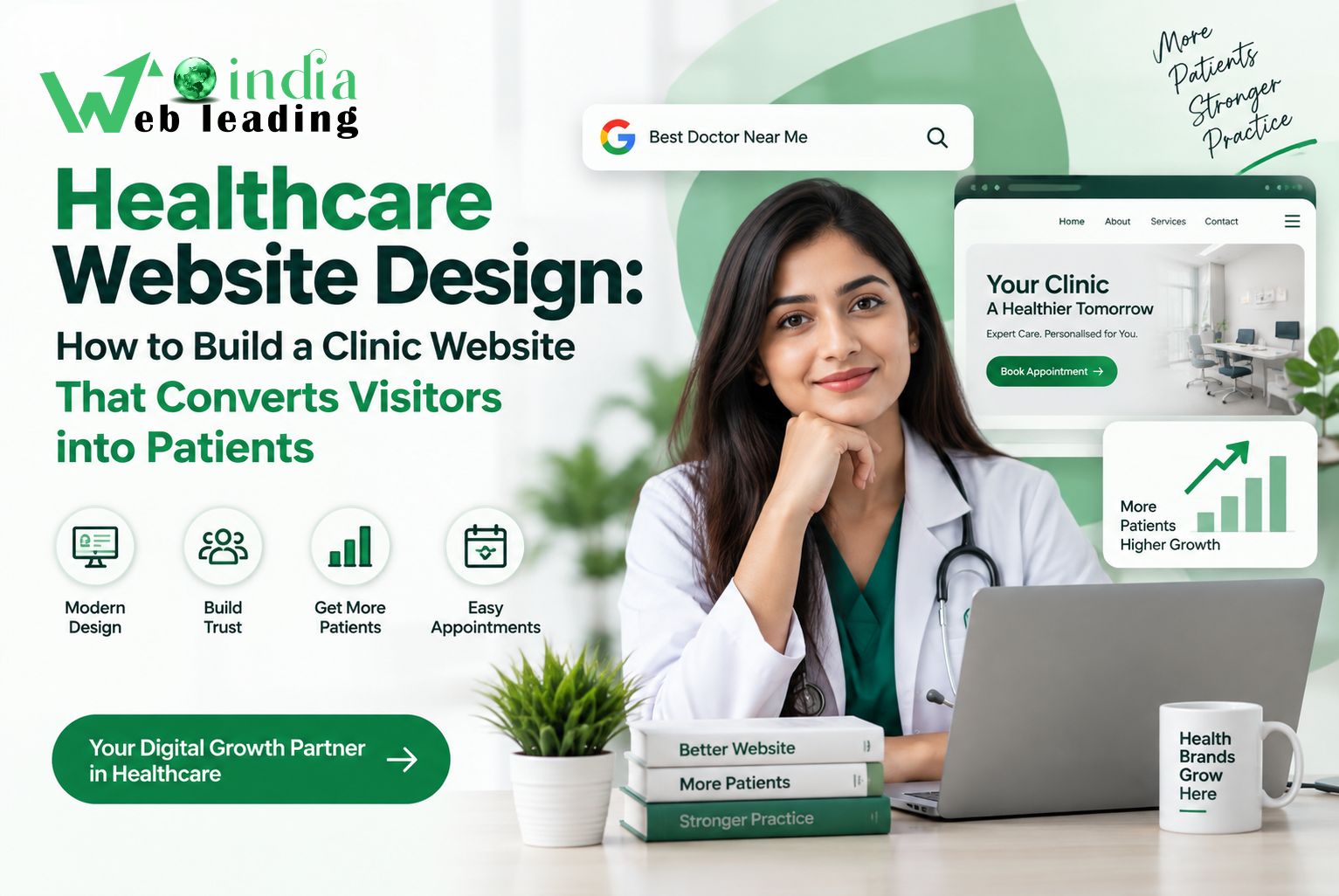
Healthcare Website Design: How to Build a Clinic Website That Converts Visitors into Patients
Introduction: Why Most Clinic Websites Fail to Convert
You have invested in a beautiful website. The colors are calming. The fonts are professional. The images look polished.
But the appointment calendar stays empty.
This is a familiar problem in healthcare digital marketing. Many clinics treat their website as a digital brochure—something that exists to look credible—rather than a patient acquisition system. The result? Traffic arrives, visitors browse, and then they leave without booking.
The difference between a website that merely exists and one that actively converts visitors into patients comes down to one critical factor: patient flow.
In this guide, you will learn the exact strategies that transform clinic websites from passive information hubs into active appointment-generating engines. Whether you are building a new site or optimizing an existing one, these principles apply to practices of every size.
What Is Healthcare Website Design? (A Simple Definition)
Healthcare website design is the process of creating a digital experience that helps patients find, understand, and access medical services. It goes beyond visual aesthetics to encompass:
- Patient flow architecture – how visitors move from landing to booking
- Trust signals – credentials, reviews, and compliance indicators
- Search visibility – how easily patients discover your services online
- Conversion pathways – the specific steps that turn a visitor into a patient
A well-designed healthcare website serves two audiences simultaneously: search engines that determine visibility, and human patients who decide whether to trust you with their care.
The Three Pillars of a Converting Clinic Website
Research on hospital website optimization identifies three core components that drive conversions: search visibility, trust architecture, and conversion flow.
Most clinic websites excel at one or two pillars while neglecting the third. Here is how to build all three correctly.
Pillar 1: Search Visibility (Being Found by the Right Patients)
Your clinic website cannot convert visitors who never arrive. Search visibility determines whether patients find you when they search for symptoms, treatments, or local providers.
Structure pages around patient intent, not internal departments.
Patients rarely search for "internal medicine department." They search for "stomach pain doctor near me" or "digestive specialist." Your website structure must mirror how patients actually search.
Create dedicated service pages.
Each treatment, procedure, or specialty should have its own page. Generic pages that bundle multiple services dilute relevance and confuse search engines. A dedicated page for "diabetes management" will always outperform a general "services" page.
Optimize for local search.
For clinics, local SEO is non-negotiable. Claim and optimize your Google Business Profile. Ensure your NAP (name, address, phone) is consistent across all directories. Add location-specific content when serving multiple areas.
Pillar 2: Trust Architecture (Reducing Patient Uncertainty)
Healthcare decisions involve fear, risk, and vulnerability. Patients need reassurance before they commit. Trust signals must appear throughout your website, not buried on an "About Us" page.
Place credentials near conversion points.
When a patient reads about a procedure and considers booking, they want to know who will perform it. Display physician credentials, board certifications, and years of experience directly beside appointment buttons.
Use patient testimonials strategically.
Reviews and patient stories are powerful conversion tools. According to healthcare marketing experts, reviews and ratings directly impact conversion strategy for high-end practices. Place testimonials on service pages, near booking forms, and throughout the patient journey.
Include compliance and privacy signals.
Patients share sensitive information with healthcare providers. Displaying HIPAA compliance badges, privacy policy links, and secure connection indicators reassures visitors that their data is protected.
Pillar 3: Conversion Flow (Making Action Effortless)
This is where most clinic websites fail. They have traffic and trust but no clear path to action.
Place CTAs throughout treatment content.
Contact forms should not exist only on the "Contact" page. Every treatment page should include appointment scheduling options within the content itself.
Reduce friction at every step.
Each additional click, form field, or decision point increases abandonment. Keep booking forms short. Offer multiple contact methods (phone, form, chat). Make scheduling available without requiring account creation.
Design for mobile-first patients.
The majority of healthcare searches happen on mobile devices. Your phone number should be tappable. Forms should be thumb-friendly. Load times should be minimal.
SEO Best Practices for Clinic Websites
A converting website is worthless if no one finds it. These SEO fundamentals ensure your clinic appears in patient searches.
On-Page SEO Essentials
Title tags and meta descriptions.
Each page needs a unique title under 60 characters containing the primary keyword. Meta descriptions should be compelling, 150-160 characters, and include a call to action.
Heading structure.
Use H1 for the page title, H2 for main sections, and H3 for subsections. This hierarchy helps both readers and search engines understand your content structure.
URL structure.
Keep URLs short, descriptive, and keyword-rich. Avoid unnecessary words and parameters.
Image optimization.
Compress images for fast loading. Add descriptive alt text that includes relevant keywords.
FAQ Schema for Healthcare Websites
FAQ sections serve dual purposes: they answer patient questions and provide structured data that search engines and AI systems use to understand your content.
Implement FAQ schema markup.
FAQPage schema tells search engines which parts of your page contain question-answer pairs. While Google restricted visible FAQ rich results to government and health websites in 2023, FAQ schema remains critical for AI search platforms like ChatGPT and Perplexity.
Keep answers concise.
Aim for 40-60 words per answer. This range balances completeness with extractability for AI systems.
Use natural question phrasing.
Write questions the way patients actually ask them. "What should I bring to my first appointment?" performs better than keyword-stuffed variations.
Common Healthcare Website Design Mistakes
Avoid these conversion killers:
Mistake 1: Treating the website as a brochure.
A website that only describes services without guiding action fails as a patient acquisition tool.
Mistake 2: Hiding contact information.
If patients must search for your phone number, you have already lost them.
Mistake 3: Overlooking mobile experience.
Desktop-first designs fail where most patients actually search.
Mistake 4: Neglecting technical SEO.
Broken links, missing sitemaps, and slow load times undermine everything else.
Mistake 5: Ignoring post-visit content.
Educational content that does not lead to booking is a missed opportunity. Every piece of content should connect to a conversion path.
FAQ: Healthcare Website Design
What is patient flow in healthcare website design?
Patient flow refers to the structured journey visitors take from landing on your website to booking an appointment. It defines how users move, what they understand at each step, and how they decide what to do next. A clear patient flow reduces hesitation and improves conversion rates without requiring more traffic.
How long should FAQ answers be on a clinic website?
Keep FAQ answers between 40 and 60 words. This length provides enough context to be useful while remaining concise enough for AI systems to extract and cite without truncation. Begin with a direct answer, then add one or two supporting details.
Do clinic websites need FAQ schema markup?
Yes. FAQ schema markup helps search engines and AI platforms understand your content structure. While visible FAQ rich results are now limited to government and health websites, the structured data improves how AI systems process and cite your content in generated responses.
How should I structure service pages on a healthcare website?
Create one dedicated page per service, treatment, or procedure. Structure content around what patients search for rather than internal department names. Place trust signals and appointment options directly within each service page to reduce steps between reading and booking.
What are the most important trust signals for clinic websites?
Essential trust signals include physician credentials placed near booking buttons, patient testimonials on service pages, HIPAA compliance indicators, and clear privacy policies. Reviews and ratings directly influence patient conversion decisions for medical practices.
How often should I update my clinic website content?
Review and update service pages, physician credentials, and patient information at least quarterly. FAQ sections should be updated as new patient questions arise. Outdated content erodes trust and can negatively impact search rankings.
Conclusion: Design for Conversion, Not Just Credibility
A clinic website that looks professional but fails to generate appointments is an expensive digital business card. The websites that successfully convert visitors into patients share three characteristics: they are findable through search, they build trust at every touchpoint, and they make taking action effortless.
Start by auditing your current patient flow. Identify where visitors drop off. Add trust signals near conversion points. Restructure pages around patient intent rather than internal logic.
Ready to transform your clinic website into a patient acquisition engine? At Web Leading India, we specialize in healthcare digital solutions designed specifically for medical practices. With over 200 healthcare clients and 5+ years of specialized experience, we understand the unique challenges of patient acquisition in the medical industry.
Let us help you build a powerful online presence that attracts more patients and grows your medical practice. Contact us today to discuss your healthcare website design needs.